
Bridging the gap between business logic and data pipeline execution remains one of the impending engineering challenges. While individual software applications manage discrete tasks across the data lifecycle, maintaining end-to-end context across isolated modules continues to rely on heavy manual coordination and developer oversight.
Experience Evolution: Interface Upgrades without Entry Point Interruption
As an integrated data management platform for the AI era, DataMind possesses capabilities spanning data modeling, batch and real-time development, data exchange, job scheduling, data services, and data governance to support the full lifecycle of data development and operations from requirements to development and O&M.
DataMind Nova is offered in two forms: Nova Governor (Web IDE) and Nova IDE (Desktop IDE). Both are seamlessly integrated into the existing DataMind develop environment, preserving established entry points while carrying out an intelligent update of the operational model. Developers move from traditional menu search, form configuration, and button-driven interaction to a new working paradigm: Goal Description - Solution Confirmation - Result Review. This upgrade significantly lowers the memory load required to navigate platform capabilities and reduces information loss when turning business requirements to technical implementation, enabling efficient and frictionless data development.
End-to-end orchestration: Intelligent Center with Connected Context
DataMind Nova extends intelligent orchestration across eight areas: data modelling, data integration, batch development, real-time development, data services, intelligent operations, data governance and platform management.
Its central breakthrough is the end-to-end context propagation. Information associated with a given data asset can be carried across the workflow from model design and development to integration configuration, job scheduling, operational monitoring and issue diagnosis. Instead of having to be synchronized manually across modules, the context is maintained and reused by the intelligent system, reducing repetitive hand-offs and allowing data engineers to focus on business requirements and critical decisions.
Critically, DataMind Nova does not replace the platform’s original specialized modules. It functions as an intelligent interpretation center with an end-to-end task orchestration engine, coordinating established platform professional capabilities for Intelligent integration of processes and automated workflow.
Modular Collaboration: Foundation Support with Clear Responsibilities
DataMind Nova operates within a four-module coordination architecture that establishes a closed-loop data development and operations pipeline with clear execution responsibilities:
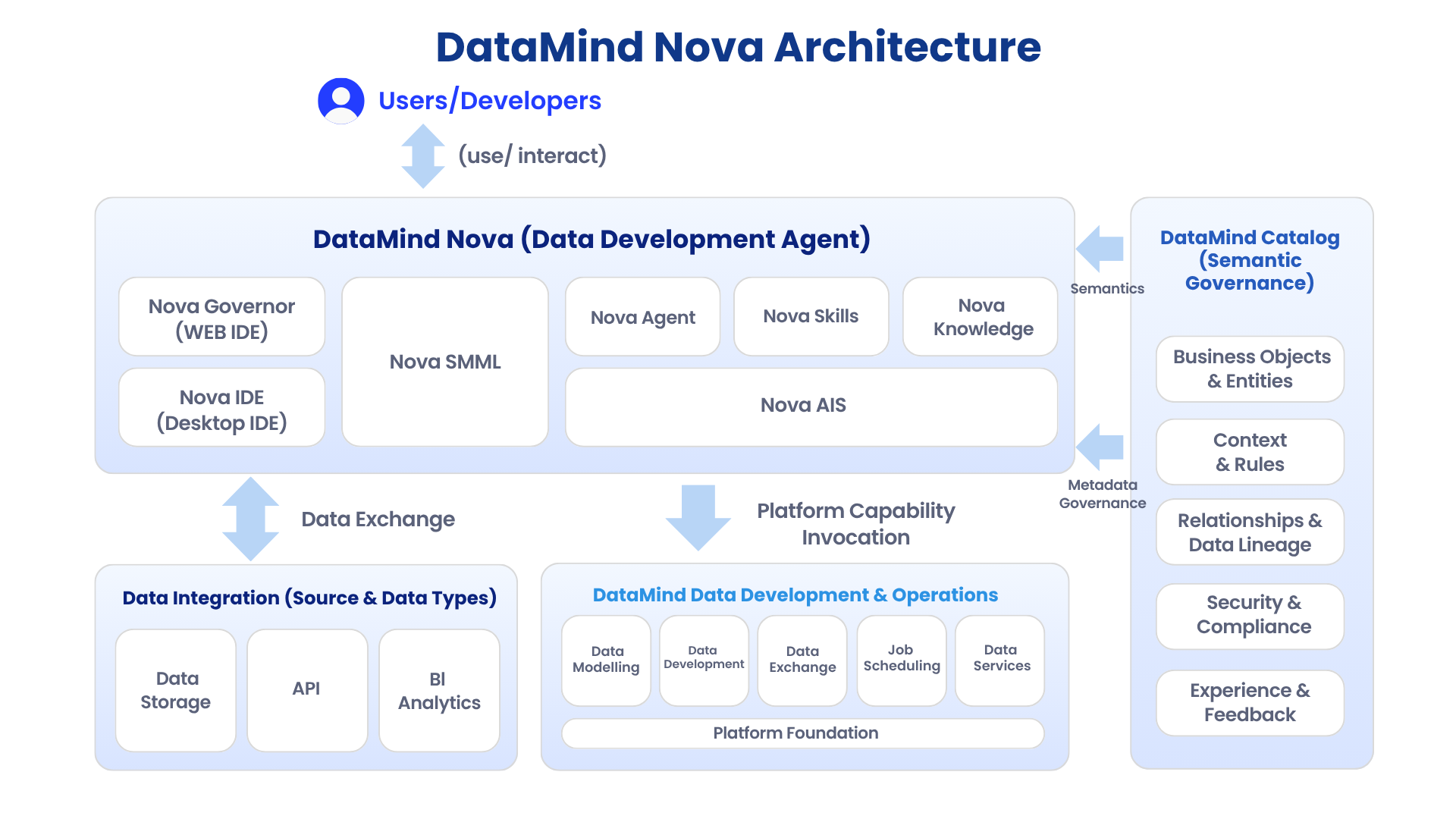
DataMind Nova: Agent Orchestration Center
DataMind Nova interprets intent and orchestrates tasks, decomposing natural-language instructions or requirement documents into dependency-ordered tasks and raising proactive clarification queries for missing information instead of acting on unverified assumptions. Rather than re-engineering underlying tools, Nova natively invokes existing platform capabilities, ensuring all operations remain verifiable and auditable.
DataMind Catalog: Semantic Governance Module
DataMind Catalog governs semantics and rules. It centralizes the management of business objects and entities, context and rules, relationships and data lineage, security and compliance, as well as experience and feedback. It guarantees metric consistency, ensuring that a single business term refers to the exact same object across design, development, data exchange, and reporting workflows.
DataMind Catalog establishes a bidirectional feedback loop with DataMind Nova: Nova draws on Catalog’s semantic definitions and governance rules when interpreting requests, while experience accumulated during execution feeds back into the semantic layer to improve subsequent interpretation precision.
DataMind DataOps platform: Professional Capability Foundation
DataMind platform executes professional workloads across data modeling, batch/real-time development, data exchange, job scheduling, and data services. All tasks, configurations, and data assets generated during execution natively persist within the original platform, remaining fully visible, manageable, and handover ready.
Data Integration: Unified Source Data Access
The data integration module provides standardized access to storage, APIs, and BI analytics, establishing a standardized data exchange interface for upper-layer operations.
Production Safeguards: Bounded Intelligent Execution
Deploying AI agents within mission-critical banking environments requires strict alignment between efficiency and enterprise risk management standards. DataMind Nova addresses safety concerns through a tiered and controllable risk execution governance framework based on operation types and runtime environments, making the intelligent production implementable, audible, and credible:
• Automated read-only analytical queries and solution generation.
• Write operations are subject to differentiated control based on the environment.
• Mandatory human-in-the-loop gateways for all execution, deletion, and release actions.
• Critical modifications trigger automated differential comparison and post-execution read-back verification establishing an auditable trail.
• Authentication credentials and access tokens are strictly confined to controlled execution pathways, preventing exposure to business query results or system logs.
Applying Financial Data Expertise at Enterprise Scale
The release of DataMind Nova consolidates data work previously scattered across modules and coordinated by manual work into a unified entry point under unified semantics. Through its agent-native architecture and clear risk boundaries, its significance lies in how it resolves the two core concerns that stall agentic adoption: bidirectional semantic governance with DataMind Catalog ensures AI reads the business correctly; tiered controls, mandatory human-in-the-loop confirmation, and credential isolation ensure agentic execution meets production safety and audit expectations.
Sunline will continue to examine DataMind Nova in real-world scenarios including requirement assessment, metric definition alignment, intelligent orchestration, and release verification, with a focus on making agentic capabilities practical within enterprise operating environments.
Stay tuned for upcoming deep dives on DataMind Nova's real-world applications across requirement evaluation, metric definition alignment, intelligent task orchestration, and production release verification