

In modern financial institutions, data engineering teams spend significant operational effort navigating fragmented DataOps toolchains. While data applications exist for specific tasks, such as requirement understanding, ETL development, orchestration scheduling, and troubleshooting, connecting these disparate tools and evaluating complex data logic continues to rely heavily on human intervention.
This represents the current bottleneck of DataOps, and it is also where intelligent agents step in.
Sunline DataMind has already established AI-ready capabilities to improve efficiency across data operations including data development, governance, and metric management & visualization. As enterprise technology evolves beyond peripheral, AI-assisted coding tools toward autonomous agentic workflows, financial technology providers are shifting focus from manual, tool-assisted data engineering to agent-native execution, where agents autonomously handle end-to-end operations, allowing users to focus on core decisions.
Aligning with this evolution, Sunline is introducing DataMind Nova, the next evolution of the DataMind platform built on an agent-native architecture. DataMind Nova integrates conversational AI agents into the platform engine to deliver end-to-end delivery and governance, advancing enterprise data management from "tool-assisted" execution into a new phase of "agentic collaboration."
Hand Data Management Over to Agents
Moving beyond external AI plugins or standalone assistants, DataMind Nova goes further to act as the core of the platform. Through a unified interface, the platform interprets business requests, designs technical solutions, and orchestrates data execution capabilities from users’ natural language prompts/ requirement documents with metric consistency under centralized governance. The system autonomously manages data modeling, batch and real-time development, data exchange, scheduling, and intelligent operations-allowing data engineers to transition from manual task execution to strategic oversight on key decisions and outcome validation.
Built on the platform's native architecture, DataMind Nova has established six core capabilities that reshape the traditional end-to-end operating model of data development and governance:
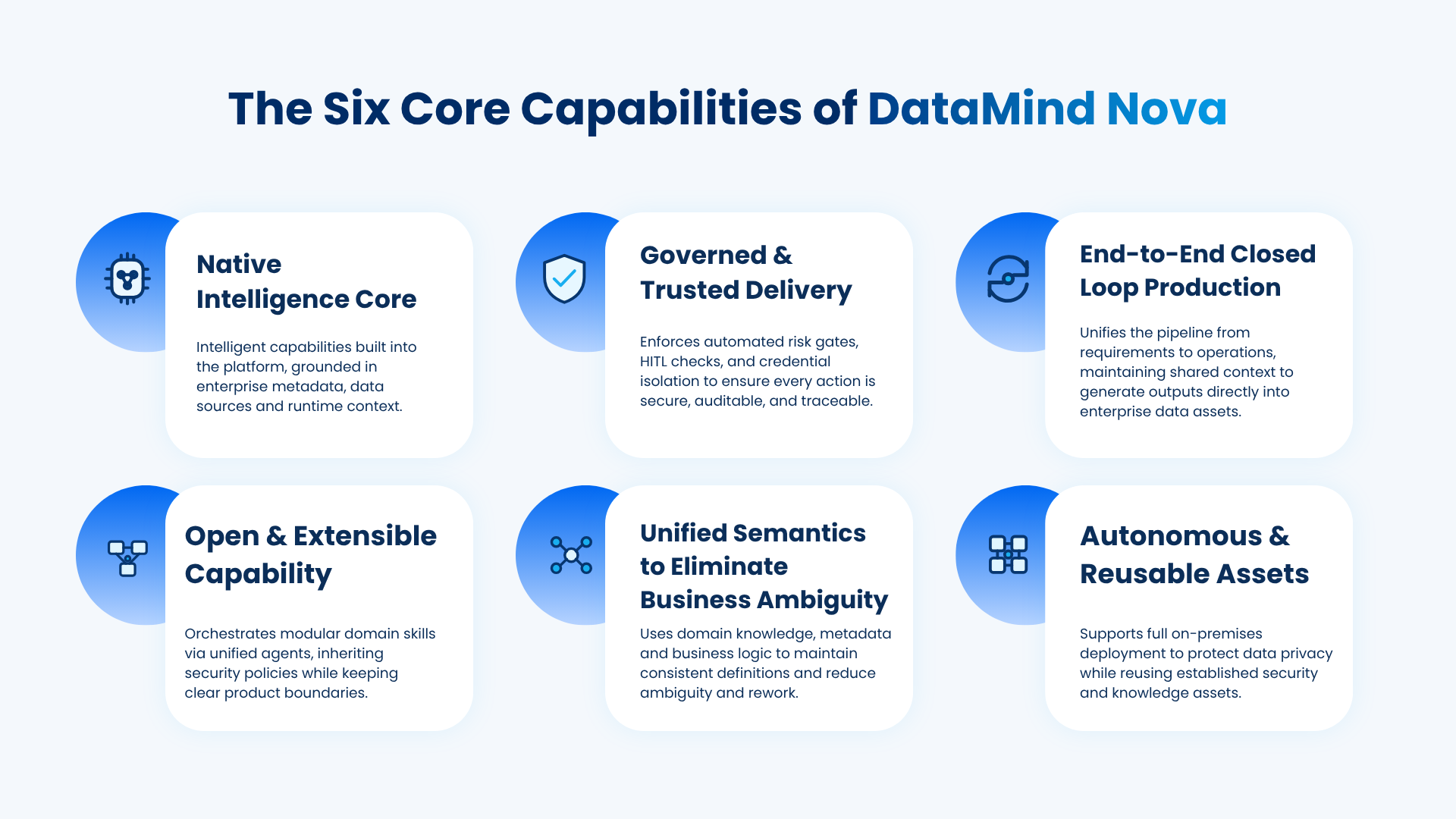
1. Natively Built-in Intelligence Foundation
• Intelligent capabilities are embedded directly into the platform core rather than added as external tools.
• Uses enterprise metadata, data sources, and real-time runtime states as execution context.
• Directly invokes existing platform capabilities to execute tasks without creating isolated operation or governance pathways.
2. End-to-End Closed-Loop Asset Production
• Establishes a unified, closed-loop pipeline with shared context throughout the execution lifecycle across requirement interpretation, modeling design, development programs, data exchange configuration, scheduling strategies, and operational monitoring.
• Outputs enter the platform directly as managed assets.
3. Unified Semantics & Resolved Business Ambiguity
• Grounded in a domain knowledge expert database, metadata, and business capabilities.
• Ensures consistent business object definitions across modeling, development, data exchange, and financial reporting, eliminating misinterpretation, ambiguity, and development rework.
4. Controllable, Auditable, and Trustworthy Delivery
• Enforces automated risk gates prior to write, execute, publish, or delete actions, routing high-risk operations to human specialists.
• Mandates diff-checks and Human-in-the-Loop (HITL) approval for critical changes, ensuring all modifications are retainable, revocable, and fully traceable.
• Excludes authentication credentials and sensitive access tokens from business query results and system logs.
5. Open & Extensible Capability Evolution
• Integrates new operational capabilities as modular domain skills, orchestrated by a unified agent orchestration.
• Newly connected skills instantly inherit standardized interaction models, change review workflows, and security policies.
• Complements existing specialized domain products while maintaining clear responsibility boundaries.
6. Sovereign Control with Efficient Asset Reuse
• Supports full on-premises deployment, keeping data assets and enterprise knowledge within the customer’s infrastructure.
• Preserves existing interaction logic, security policies, and knowledge assets as new capabilities are onboarded.
A New Operating Model for Enterprise DataOps
Leveraging the six native capabilities, DataMind Nova resolves the pain points of traditional data tools, including fragmentation, disconnected workflows, and governance difficulties:
Efficiency: Closed-Loop Execution and Shortened Delivery Pathways
From requirements understanding to runtime handling, work completes within the single conversational context, and outputs enter the platform directly as managed assets without inter-sectional re-description, conversion, and repeated entry that lengthen delivery paths.
Trustworthiness: Governed Processes and Traceable Results
Semantics and metric definitions are governed by a unified semantic layer. Changes are applied through difference checks combined with human confirmation, and high-risk actions are escalated to human handlers, keeping delivery quality and compliance predictable and auditable.
Extensible: Skills Accumulation and Assets Reusability
Agent capabilities connect as modular domain skills. Established interaction logic, security policies, and knowledge assets remain in effect and can be reused across projects, with sovereign control via on-premises deployment.
Looking Ahead
Transitioning to agent-native data management restructures data engineering productivity. DataMind Nova addresses the fragmentation that has long limited DataOps, while agentic execution remains compatible with the audit and compliance expectations of regulated financial institutions. DataMind Nova reshapes data development, governance, and delivery architectures, making data operations more efficient, secure, and sustainable.