

Every major change to a banking core-version release, architecture upgrade, or core migration-face three critical operational hurdles: verifying behavioral consistency between legacy and target environments, achieving comprehensive test coverage under real-world conditions, and rapidly isolating root-cause anomalies. Failing at any of these checkpoints introduces severe project delays, cost overruns, and rollback risks.
Sunline’s Transaction Replay System (TRS) was developed to address these challenges by bringing production-grade transaction replay into financial system validation. First deployed commercially in 2018, TRS was engineered to revolutionize go-live decision-making from subjective experience into verifiable data proof.
Pioneering Production-Grade Replay
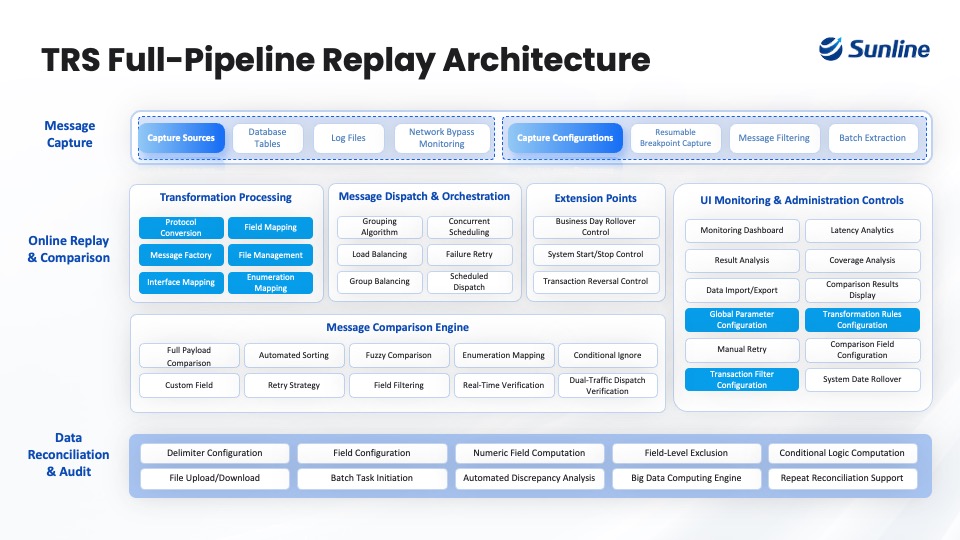
Unlike traditional testing methodologies that suffer from synthetic scenario distortion, timing discrepancies, coarse variance analysis, and reliance on manual test cases, TRS establishes a Six-Layer Replay Pipeline:
Collection - Transformation - Scheduling - Comparison - Verification - Governance.
By leveraging actual production traffic as the single source of truth, TRS replicates live transaction timing and concurrency. Through intelligent comparison, automated closed-loop remediation, and multi-tier verification safeguards, the system provides high-fidelity, traceable behavioral comparison between legacy and modernized platforms. It fundamentally solves verification challenges in financial system iteration, architecture upgrade and core migration, ensuring smooth system change rollout.
Enterprise Adoption: Proven Across the Banking Spectrum
Since its initial deployment, TRS has undergone continuous functional refinement, evolving a capability system of six core capabilities and three fallback safeguards. It has established a proven track record across policy banks, state-owned commercial lenders, joint-stock institutions, and regional banks.
Its capabilities are designed to deliver shorter validation cycles, higher‑quality testing, faster fault remediation and robust business continuity for system transformations. and support business continuity during system changes.
Six Core Capabilities
• Authentic Production Collection: Captures message-level production data across databases, file systems, Agents, and network interfaces, eliminating reliance on artificial test data.
• Microsecond-Level Precision: Replicates 1:1 production rhythms using microsecond timestamps, time-slice scheduling, and intra-group sequence preservation to enable the replay process to reproduce production transaction sequences with high fidelity, with configurable timing rules for time-sensitive workflows.
• Empirical Credibility: Implements a three-tier comparison featuring error-code equivalence mapping and field-level noise reduction, logging transaction-level audit trails and data-based verification to support cutover evaluations, all comparison results are persisted in database per transaction and serve as key evidence for system cut‑over review, shifting go‑live decisions from experience‑driven to data‑driven.
• Closed-Loop Remediation: Incorporates a built-in redo state machine that automatically re-executes and re-compares transaction discrepancies, recording full lifecycle audit trails.
• Centralized Governance: Consolidates governance across ten business domains within a unified console, enforcing Role-Based Access Control (RBAC) and compliance audit trails for traceable operation.
• Modular SPI Architecture: Utilizes a Service Provider Interface (SPI) framework supporting over 12 messaging formats and host callbacks, allowing plug-and-play integration for new target systems without impacting core execution paths.
Three Safeguards Mechanisms
• Big-Data Batch Reconciliation: Executes cross-verification across full datasets using a dual-source big data engine, pinpointing discrepancies down to individual data cells.
• Non-invasive Integration: Collects telemetry via bytecode agents without modifying underlying application source code or introducing operational risk.
• Full Scenario Coverage: Unifies diverse testing requirements into a single platform, eliminating toolchain fragmentation.
From Pre-Cutover Assurance to Continuous Validation
Initially developed for parallel core system validation, TRS has expanded its operational scope across the entire application lifecycle:
• Pre-Launch Automated Regression: Replaces manual-written test scripts with live production traffic, automatically executing multi-environment regression tests across complex edge cases.
• Post-Launch Continuous DR Verification: Supports dual-traffic dispatch comparison and live shadow tracking. This enables non-intrusive, continuous disaster recovery environment testing without occupying active maintenance windows or disrupting live operations.
• End-to-End Workflow Coverage: TRS spans all production scenarios: online real-time transactions and back-office batch jobs, including batch account opening and payroll agency and deduction runs. Beyond core banking engines, its capabilities extend to credit card processing and payment networks, adapting to each domain's distinct online and batch characteristics.
Looking Ahead
Sunline is advancing TRS toward smarter comparison, earlier risk identification, and faster root-cause analysis. As financial institutions navigate cloud-native migrations and architecture upgrades, production-grade replay is becoming part of the standard assurance stack, positioning validation not as a project phase, but as a standing capability for operational resilience and risk-mitigated platform transformation.