

Core banking modernization remains one of the most complex operational challenges in financial technology. As financial institutions seek to accelerate digital transformation and improve market responsiveness, legacy infrastructure introduces significant engineering friction.
Much of a bank's critical business logic-such as business rules, product configurations, transaction flows, parameter logic, and exception handling remains trapped within legacy codebases and dependent on the tacit understanding of senior engineers. This concentration of tribal knowledge creates key-person risk, elevates the cost of change, and increases operational risk during platform updates. While generic AI coding assistants have improved individual developer velocity, they lack the domain context, end-to-end traceability, and governance required for mission-critical financial infrastructure.
Addressing this bottleneck, Sunline has introduced Luban, an AI-Native Software Development Life Cycle (SDLC) platform engineered specifically for core banking and enterprise financial systems. Rather than acting as a standalone coding assistant, Luban provides an AI-native engineering workspace across the full SDLC. It coordinates agent-driven execution, human oversight gates, and continuous knowledge institutionalization, helping banks convert dispersed tribal knowledge into standardized, traceable, and reusable engineering assets.
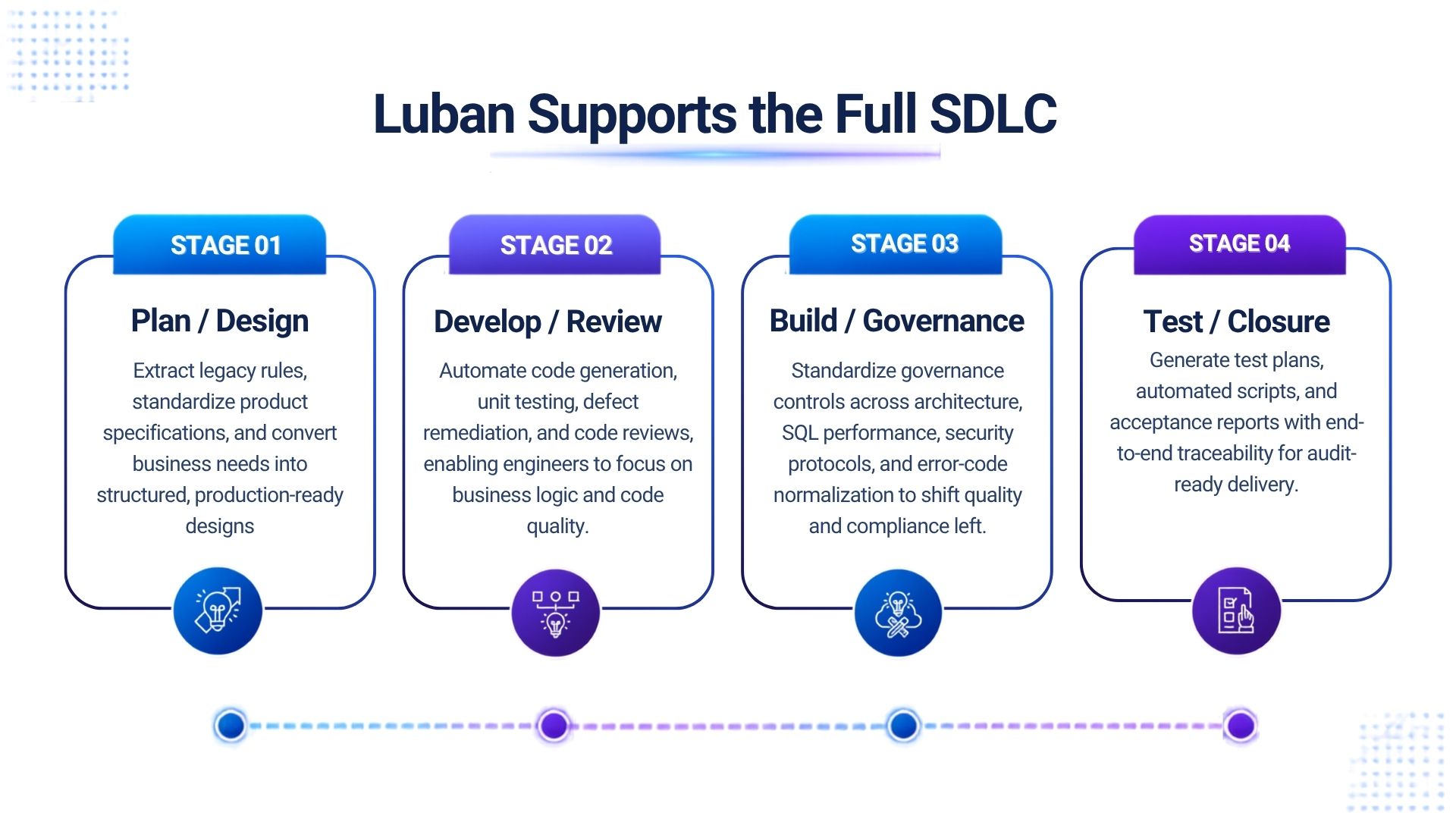
Implementing Human-Agent Collaborative Operations Across Four SDLC Stages
Sunline encapsulates two decades of core banking domain expertise, technical standards, and quality governance frameworks into Luban’s reusable agent matrix. The platform embeds human-in-the-loop (HITL) collaboration across the software delivery lifecycle:
Plan / Design: The platform automatically extracts legacy business rules, standardizes product specifications, and performs requirement elicitation and gap analysis. It formalizes application, database, and API contract designs, converting ambiguous business needs into structured, production-ready delivery assets.
Develop / Review: Luban automates repetitive engineering tasks including code generation, unit testing, defect remediation, and code review. This allows engineers to focus on validating deliverables, optimizing business logic, and managing code merges, improving both productivity and code quality.
Build / Governance: Luban standardizes governance controls across architectural layering, SQL performance, resource scheduling, security protocols, and error-code normalization. This shifts quality assurance, security, and regulatory compliance left across the development pipeline.
Test / Closure: The system generates comprehensive test plans, cases, automated scripts, and acceptance reports. By establishing end-to-end traceability from business requirements to test execution, it ensures deliverables remain fully verifiable and audit-ready.
From Tribal Knowledge to Institutional Assets
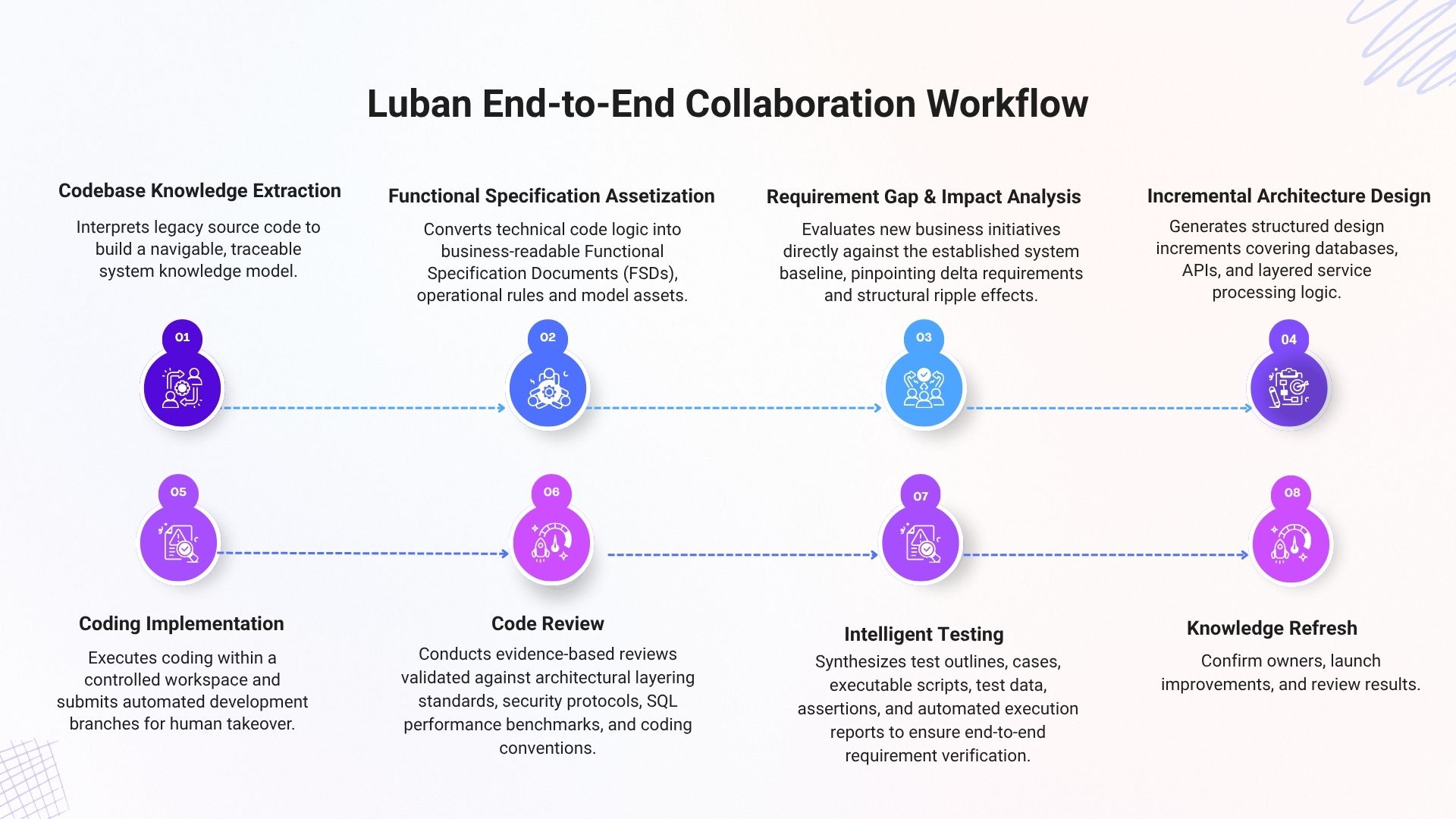
By connecting requirements, code, configuration and test artefacts, Luban creates a continuously updated knowledge base that can support software analysis and development across the R&D lifecycle, reducing dependence on individual experts while making existing system knowledge more accessible to engineering teams.
The platform also introduces multi-agent orchestration across activities including AutoBA, AutoTA, AutoDev, and AutoQA. Instead of relying on a single general-purpose AI assistant, specialized agents can perform different tasks within a structured engineering workflow, achieving highly efficient cross-functional collaboration.
Human oversight remains part of this process. AI execution is constrained by standard operating procedures (SOPs), visual task boards, and mandatory human oversight gates. All design, code, and test artefacts are automatically reconciled and fed back into the central knowledge pool, ensuring continuous institutional learning.
A Governed, Knowledge-Centric Architecture
The platform is built on a three-tiered architecture designed to balance automated execution with risk management. Validated in the core deposit account opening transaction scenario, this layered architecture demonstrates the capability to enhance R&D efficiency, while improving traceability and sustainable knowledge reuse.
• SunTCR (Taishan Code Reader): The platform reverse-engineers legacy code, configurations, and historical artefacts into a structured, machine-readable institutional knowledge graph, effectively eliminating information silos.
• AIS Agent Foundation: Acts as the orchestration layer, managing context memory, process orchestration, and agent coordination across complex tasks.
• Luban Application Layer: Luban encapsulates domain-specific application capabilities and a specialized multi-agent matrix designed for end-to-end software R&D delivery.
For banks undertaking long-term platform modernization, the ability to preserve institutional knowledge, standardize engineering processes, and establish governed AI workflows can become an important component of technology resilience.
Luban positions AI-Native SDLC as an engineering model in which knowledge, agents and governance work together across the software lifecycle. For financial institutions, this provides a potential path from developer productivity gains towards a more sustainable engineering capability-one that is less dependent on fragmented expertise and better equipped to manage the complexity of continuously evolving banking platforms.