

As banks move from experimentation with generative AI towards production use, the challenge is shifting from what AI can generate to whether it can operate reliably within enterprise data environments. For financial institutions, an AI response is only useful when it reflects the right business definitions, follows governed processes, and can be traced back to an auditable execution path.
Sunline’s DataMind data intelligence platform addresses this challenge by combining semantic modelling with an enterprise Agent framework, embedding Agent capabilities directly into the platform foundation rather than treating them as standalone tools. The approach is designed to connect business context, data assets, and execution, eliminating hallucinations in large language models (LLMs) and creating a more controlled foundation for AI-enabled data operations.
From Data Storage to Domain Knowledge
A common limitation in data lakehouse environments is that models often describe physical tables rather than business meaning. Metrics, dimensions, and entities may exist in technical structures, but the business logic connecting them is not always explicit. This creates ambiguity when AI systems interpret financial concepts or generate queries.
• Entity-Centric Semantic Layer: DataMind constructs multi-dimensional knowledge graphs centered on core financial entities. By mapping business terminology (such as net interest margin or non-performing loan ratios) directly to physical data execution logic, the platform provides explicit context to the underlying models. This structural alignment eliminates derivation ambiguities and ensures explainable output for every query.
• Bridging the Knowledge Gap: DataMind addresses model hallucinations at the architectural level by combining a domain-specific semantic layer with deterministic execution protocols. By mapping business terminology directly to physical data execution logic, the platform provides explicit context to the underlying models, eliminates derivation ambiguities, and ensures explainable output for every query.
From AI Assistance to Governed Execution
Semantic context addresses what AI needs to understand; the Agent framework addresses how tasks are executed.
DataMind incorporates six core architecture features for enterprise AI operations, advancing the platform from a conversational tool into an enterprise-grade intelligent workbench:
• Multi-Tenant Governance: Centralized management of agent assets, knowledge bases, and scheduled workflows across enterprise teams throughout the asset lifecycle.
• Two-Tier Knowledge Base and Intelligent Retrieval Architecture: Connector-driven integration with existing IT assets utilizing the two-tier architecture to balance knowledge sharing with strict data isolation, while dual-path retrieval ensures the accuracy of financial-grade Q&A.
• Plan-Based Execution Framework: Complex tasks are decomposed into defined steps, checked before progression, and recorded for audit purposes. This approach is intended to make AI behavior more deterministic and suitable for production environments.
• Standardized Capability Packaging: DataMind supports modular packaging of Agent capabilities, enabling standardized circulation and dynamic loading of Agent assets.
• Seamless Resource Integration: Support from Agent-Mode-Package specification and the Model Context Protocol (MCP) enables agents to connect with external tools and resources in a standardised way, supporting broader integration across the banking technology infrastructure.
• Secure Sandbox Runtime Environment: Execution of sensitive data tools within MicroVM sandbox environments, ensuring isolated, policy-compliant execution boundaries.
Moving Data Operations Towards Automation
Deployed within multiple banking environments, DataMind demonstrates measurable productivity gains across three core operational scenarios:
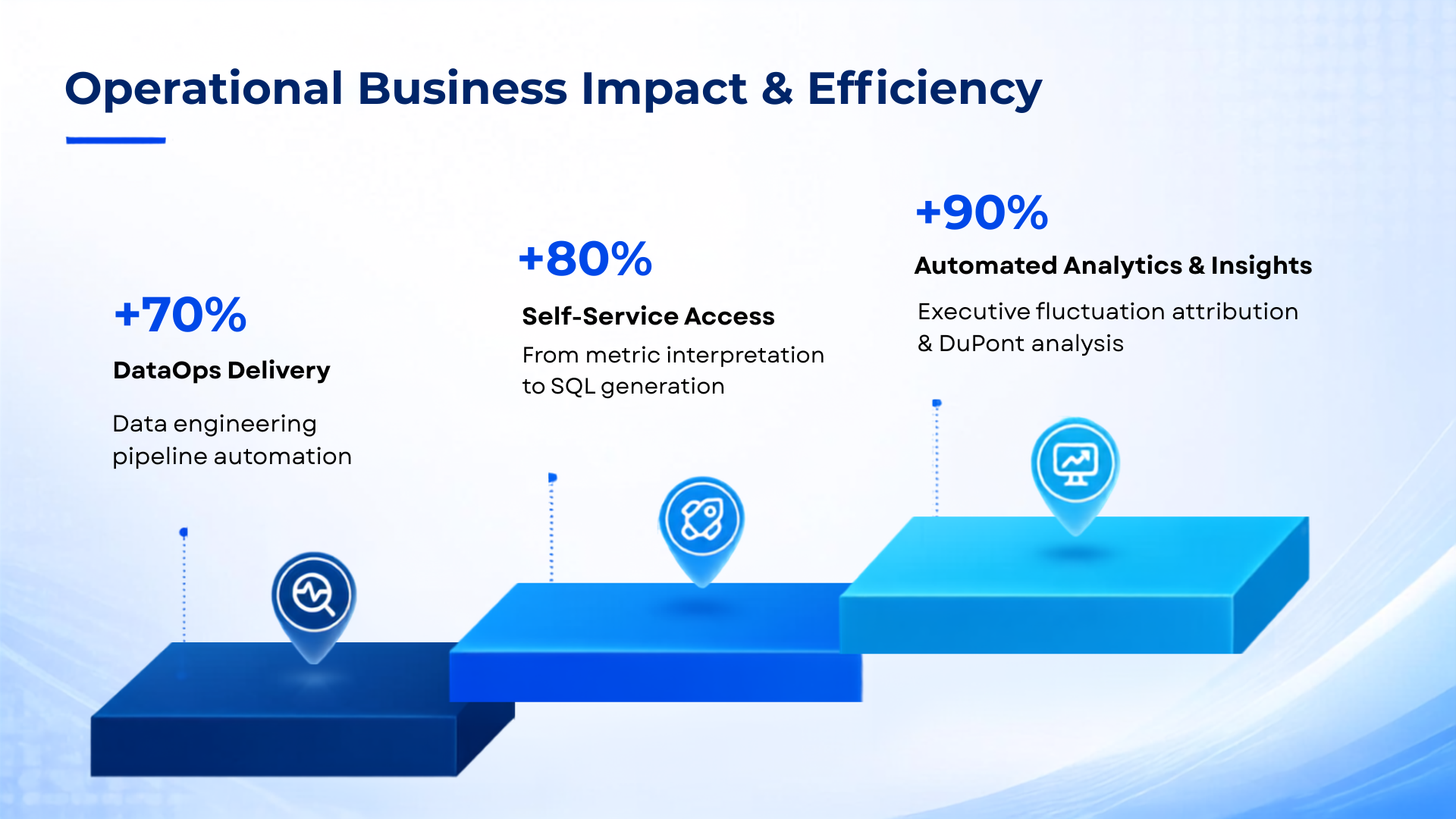
• DataOps Delivery: DataMind establishes a collaborative mechanism consisting of a Master Control Agent, five categories of Agents covering offline development, real-time development, batch scheduling, data services, and intelligent operations, and an Audit Agent. This mechanism automates an end-to-end closed-loop pipeline creation from natural-language requirements to production deliverables, achieving a 70% increase in data engineering efficiency.
• Self-Service Data Access: Semantic modelling supports the process from metric interpretation to SQL generation and visualization, with a reported 80% improvement in self-service data access efficiency.
• Automated Analytics & Insights: Agents support tasks such as metric fluctuation attribution and DuPont analysis, generating visual reports and accelerating executive insight generation by 90%.
These results point to a broader shift in enterprise data operations: AI is moving beyond an interface for individual tasks and becoming part of the underlying development and execution workflow.
Building a More Governed Foundation for AI in Banking
By integrating semantic modeling with enterprise agent orchestration, Sunline DataMind provides a deterministic bridge between complex raw data assets and strategic decision-making, delivering operational resilience, strict regulatory alignment, and verifiable engineering efficiency.
As banks progress towards more AI-enabled operating models, these foundations will become increasingly important in determining whether AI can move from individual productivity use cases into repeatable, enterprise-scale data operations.