
As Generative AI accelerates across the financial sector, the limitations of traditional data models are becoming dangerously apparent to safety and compliance risk. Built as static structures for human analysts, the legacy data models lack the dynamic business semantics that AI requires. This semantic gap leaves AI struggling to understand true business context, leading to reasoning errors, AI hallucinations, and severe compliance risks.
To solve this critical industry bottleneck, Sunline has announced a major architectural upgrade to its DataMind platform. By transitioning data management from "static reporting" to "cognitive-driven" intelligence, DataMind bridges the gap between raw data and business logic using Ontology and Multi-Agent System.
The Evolution of the DataMind Architecture
Traditional lakehouse architectures face three major pain points in the AI era: semantic gaps, data hallucinations, and permission black boxes. To overcome this, DataMind introduces a dual-engine architecture: physical Lakehouse Storage Layer paired with a Cognitive Semantic Layer (Ontology).
This approach breaks down the boundaries of traditional data processing. It transforms massive data sets into living knowledge embedded with native business logic. AI is no longer just retrieving data; it is understanding relationships, grasping business fundamentals, and outputting highly trustworthy results, just like a senior business expert working on duty.
DataMind’s Dual-Engine Architecture
A new standard is emerging as data management shifts from isolated silos to human-AI collaboration. The focus is no longer just asking, "Which table is this data stored in?" Instead, the new approach asks: "What does this data mean to the business, and how is it connected to everything else?" This creates a web of business relationships that machines can easily understand, marking a massive leap from flat, two-dimensional data storage to a multi-dimensional, intelligent understanding of your business.
DataMind turns this concept into reality through a proven six-step workflow: 1. Requirement Analysis → 2. Ontology Design → 3. Data Mapping → 4. Data Exploration → 5. Action Development → 6. Business Review. Supported by Large Language Models (LLMs), it seamlessly transforms abstract business concepts into executable data models.
By using this intelligent semantic layer as its core engine, DataMind delivers value to banks in three key ways:
• Injecting business common sense into AI: By explicitly defining the semantic relationships between "Customer → Product → Event," DataMind fundamentally mitigates Large Language Model (LLM) hallucinations.
• Conversation as development: Business users can now use natural language to describe requirements, with the system automatically generating rules and execution scripts.
• Building core cognitive assets: As the business evolves, these semantic models accumulate, becoming irreplaceable, proprietary digital assets for the bank.
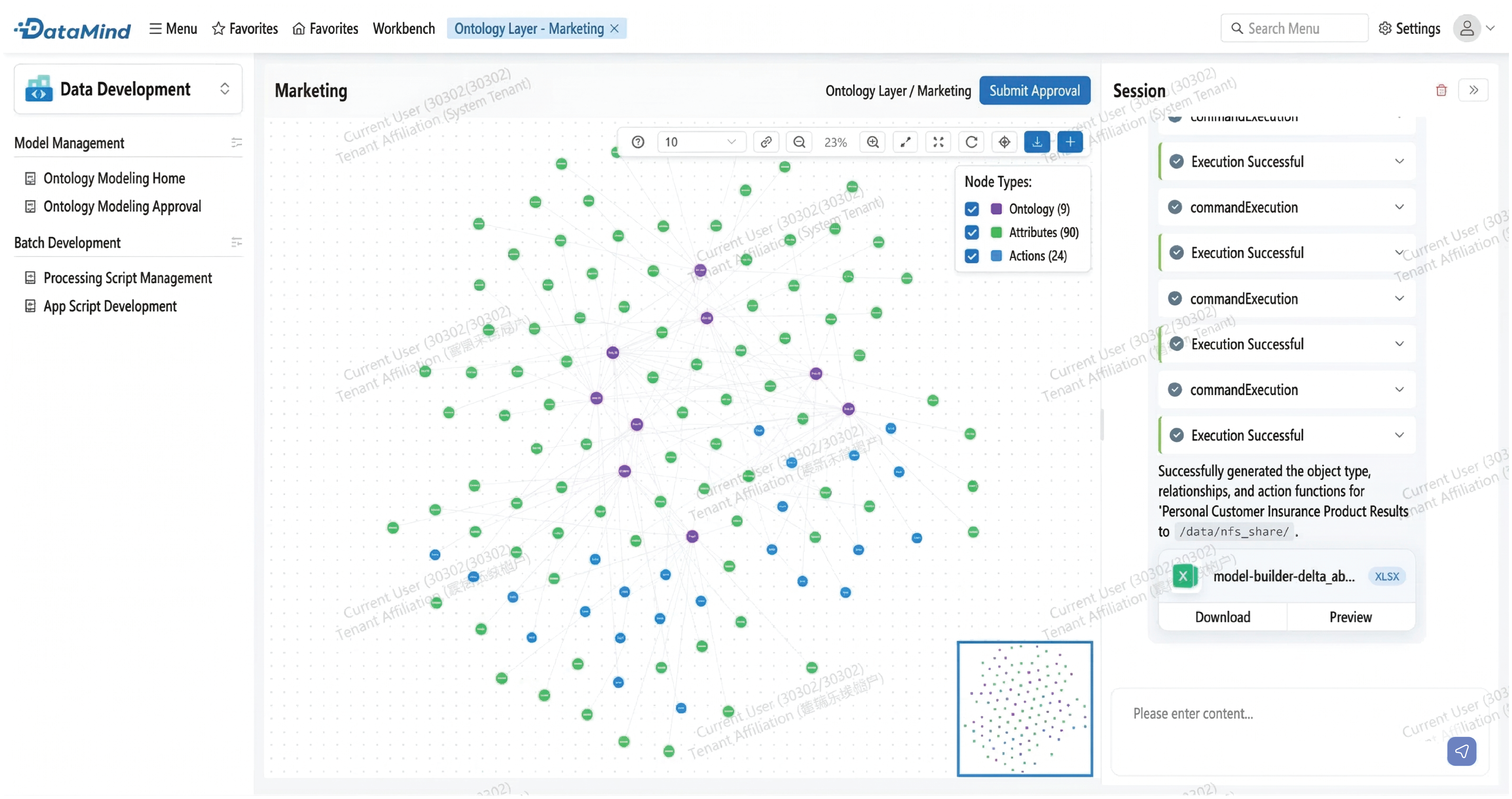
The Intelligent Agent Ecosystem
In real-world execution, DataMind leverages a collaborative network of intelligent agents to build a complete, end-to-end data modeling pipeline:
• Intelligent Modeling (Model Agent): Users can now describe their goals using large language. For example: "Build a customer-product model for retail insurance and include risk attributes." The Model Agent instantly understands the request, applies built-in business logic, and generates a complete semantic model (previewed in a familiar Excel-like interface). Once approved, the model is published instantly, compressing a process that used to take days down to just minutes.
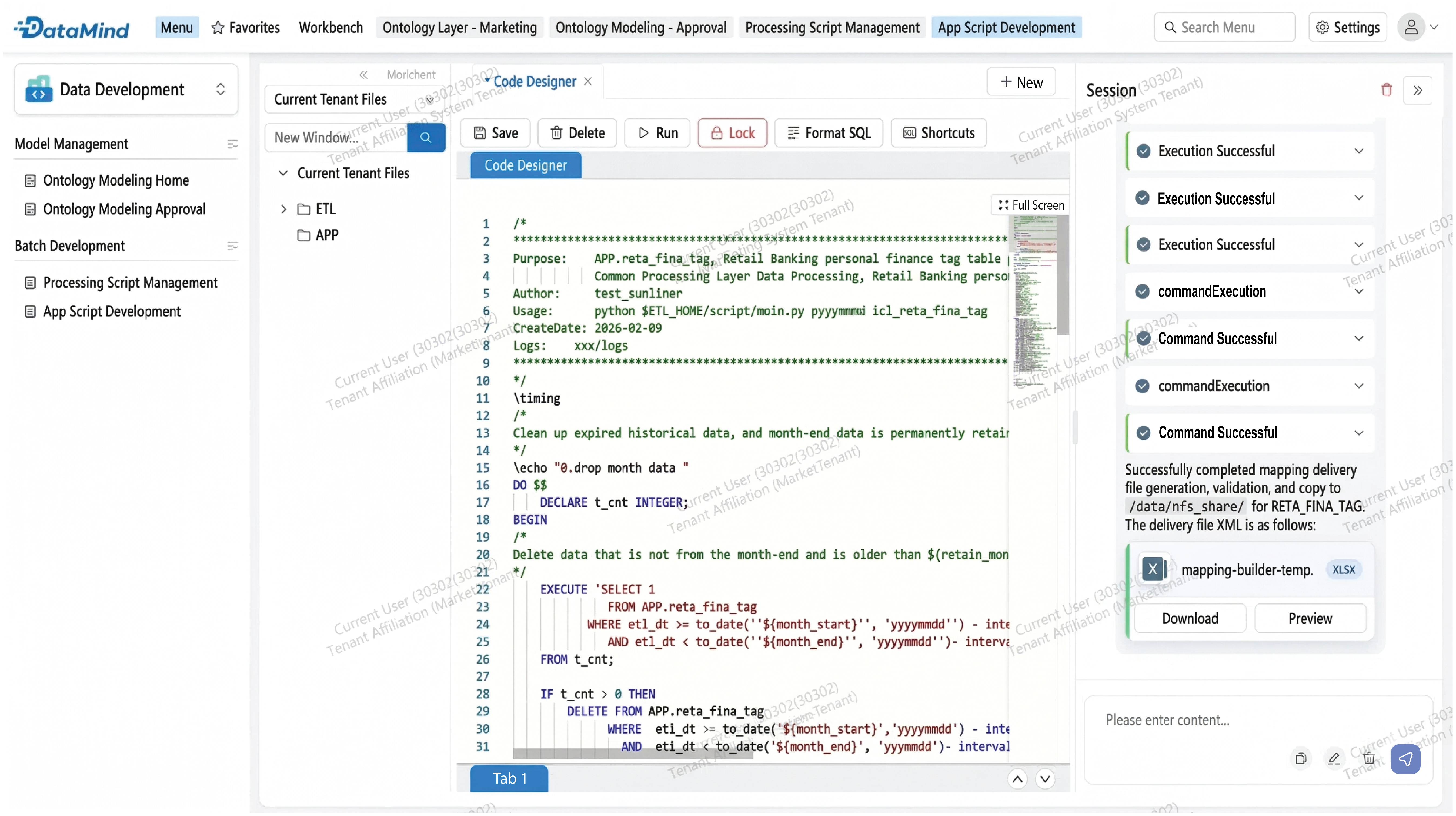
• Automated Rule Generation (Mapping Agent): When building reports, users simply describe their desired table structure or upload a physical model file. The Mapping Agent automatically analyzes the relationships and generates ready-to-use mapping rules and ETL scripts. This creates a seamless pipeline from the underlying data layer straight to your business applications.
Proving the Value: Re-inventing Precision Marketing
The true test of any architectural upgrade is the ROI it delivers in the real world. Traditionally, launching a bank's precision marketing campaign is a clunky, cross-departmental relay race. It takes 3 to 5 days of manual audience filtering, rule configuration, and performance analysis. DataMind changes this entirely. By combining its core data models with a five-agent ecosystem (Model, Mapping, Plan, Simulate, and Report Agents), the platform transforms "blind outreach" into an intelligent, closed-loop marketing engine.
In retail wealth management scenarios, the business impact is massive:
• Faster Time-to-Market: Campaign launch cycles are slashed from 5 days down to just 2 hours.
• Smarter Targeting: Customer profile coverage is increased by 50%.
• Reduced IT Bottlenecks: Repetitive SQL coding is reduced by 80%.
Most importantly, business operators no longer need to wait on IT to pull reports, they can simply "chat" with their data to make immediate, informed decisions.
The Path to an AI-First Future
From architectural evolution to proven market execution, Sunline continues to pioneer technology that answers the demands of the AI era. As the financial sector accelerates its digital transformation, DataMind equips banks to finally break down the barriers between raw data and business logic. It empowers financial institutions to move beyond experimental "+AI" projects and transition into a truly strategic, "AI-First" enterprise.