

At the recent Huawei Thailand Digital & AI Summit 2026held in Bangkok by Huawei and Thailand’s Ministry of Digital Economy and Society, more than 3,000 government representatives, enterprise customers, telecom operators and ecosystem partners examined how trusted AI, advanced connectivity, computing capabilities and open ecosystems can support Thailand’s digital economy and its ambition to become a leading AI hub in ASEAN.
For Thailand’s banks, these developments are reshaping both operational priorities and investment decisions. Rising digital transaction volumes are placing greater demands on processing capacity and performance, while expectations of 24/7 access are making system availability and operational continuity business-critical. Meanwhile, subdued loan growth and pressure on profitability are increasing management scrutiny of transformation spending.
Digital Scale Is Redefining the Economics of Core Modernisation
Thailand’s banking system already operates at significant digital scale. Within this environment, core banking modernisation extends beyond technology replacement. It is an enterprise transformation intended to strengthen operational resilience, accelerate business change and establish the trusted data foundation required for wider adoption of AI.
According to the Bank of Thailand’s 2025 Annual Report, PromptPay averaged 74.6 million transfers a day and reached a single-day peak of 96.2 million transactions. At this scale, the operating requirement is twofold: absorbing peak transaction volumes efficiently while keeping essential banking services continuously available. Performance and availability are therefore no longer simply technology measures. They are business-critical determinants of service continuity, customer trust and operational reliability.
The investment environment is also becoming more demanding. Banking-system loan growth was limited to 0.2% year on year in the first quarter of 2026, while profitability declined as lower lending rates reduced net interest income. Together, these conditions create a dual imperative: sustaining operational resilience while applying greater discipline to transformation spending. Core modernisation is therefore increasingly judged by measurable business value, controlled execution and credible returns, rather than technology renewal alone.
Drawing on 24 years of experience in banking technology and transformation, Sunline views core modernisation as a management and operating-model decision. The central questions concern where investment will create the greatest value, which business domains to prioritise, how much transition risk the institution is prepared to carry and what evidence will justify further commitment. Effective programmes begin with defined business outcomes and establish clear decision points for migration scope, governance and subsequent investment.
Turning Banking Priorities into a Controlled Modernisation Path
No single modernisation path applies to every institution. A bank’s target operating model, priority business outcomes, risk appetite and existing technology investments determine whether the appropriate route involves broad core replacement, migration by business domain, digital-core coexistence or data-first transformation. These considerations also shape the scope, pace and sequencing of change.
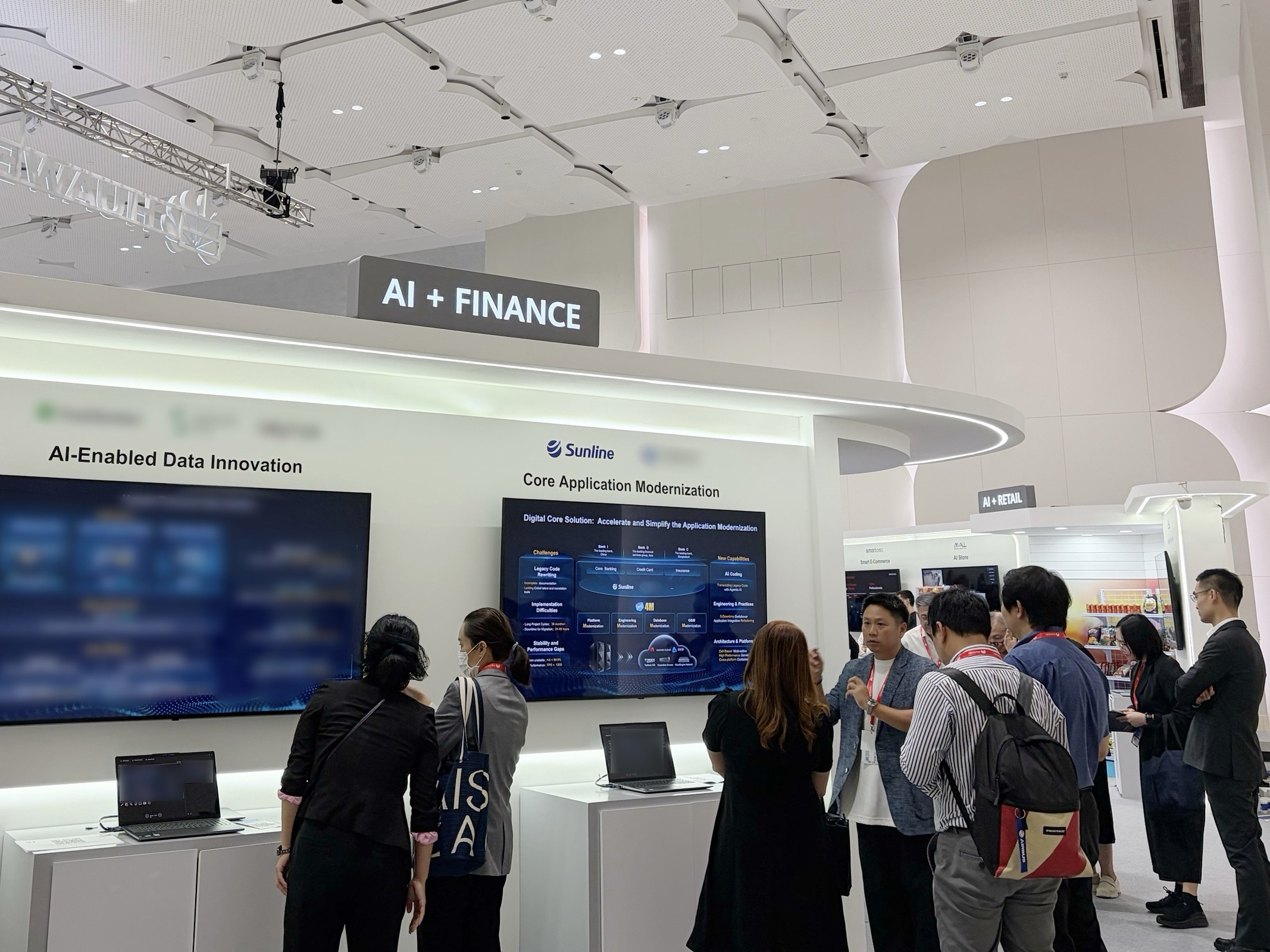
Where phased coexistence is selected as the transition model, Sunline’s multi-core coexistence layer enables banks to modernise in controlled stages rather than migrate all business domains through a single large-scale cutover. SunCBS allows priority domains to move progressively while existing accounts and unmigrated functions remain on the incumbent core. Account location, transaction routing and cross-core processing maintain continuity between the two systems, while reconciliation, monitoring and validation provide control at each stage. This allows banks to verify service continuity, data consistency and operational readiness before expanding the migration scope, helping to contain and reduce migration risk.
Sunline’s “One Platform, Two Cores” approach connects scalable transaction processing with the bank’s wider data and AI agenda. APStack provides the shared cloud-native technology platform, with SunCBS serving as the transaction core and DataMind as the data core. SunCBS captures trusted business events from daily banking operations, while DataMind transforms this information into governed, reusable data assets that support regulatory reporting, management analytics and real-time data services.
APStack connects both cores through common integration, API, service orchestration, monitoring and deployment capabilities. This enables transaction processing and data services to operate on a consistent platform rather than as disconnected systems. AIS provides the AI agent orchestration layer, with its current application centred on software engineering productivity through SunTCR. Business-oriented capabilities, including fraud and risk alerts, credit decision support and customer service assistance, form part of DataMind’s future development roadmap.
Together, these capabilities establish a progression from trusted transaction data and governed information assets to real-time analytics and, over time, AI-assisted decisioning. Banks can strengthen their data foundations as part of core modernisation while maintaining clear governance over how AI capabilities are introduced into banking operations.
Advancing core modernisation across Thailand’s banking sector requires alignment between banking expertise, enabling technologies and local execution. Sunline will continue to collaborate with Huawei and ecosystem partners to bring these capabilities together. By combining banking-domain and migration expertise with complementary technologies and local delivery capabilities, this ecosystem enables institutions to move from strategic intent to controlled execution, aligning modernisation with business priorities, regulatory obligations and target operating models.